So who is this man? He's Dr Richard Liston, he has a PhD in Computer science and was once a professor at Ursinus College. You would think after securing a teaching position at an exclusive liberal arts college he would sink comfortably into the comfortable middle class lifestyle of a bourgeois intellectual. But no. Richard is one of those people who is always curious about what's beyond the horizon and asking what's next.
This became the beginning of the Sphere College Project.
As good as a college education can be, the question came up can it be improved? As colleges and families strain under the pressure to cover the expense of higher education, colleges are forced to be more like advanced trade schools then institutions of intellectual pursuit. Students are taught more and more on how to do things and gear themselves to employers needs -what gets lost is the ability to think.
It's difficult to quantify the ability to think. Thomas Edison is often quoted that genius is 1% inspiration and 99% perspiration; and many people ignore how much value Edison placed on that 1% of the process. Without that 1% inspiration, the spark of creativity, the actual thought launches an idea -the other 99% becomes mindless toil. Economists have talked about the rise of the "creative class" and how they the new engine of economic development.
Classes at Sphere are available for the intellectually curious and people who are interested in expanding their horizons.
Local Sphere is at 12 North Main Street in Phoenixville PA. In the front half of this commercial space is an artist gallery where local artist can rent space at a fair price. Behind that is space for classes.
I had a friend who always said "luckier than a three legged dog" . Never knew quite what he what meant by that but one of the neighbors brought over his beloved pet and rescue dog to the grand opening of Local Sphere. I think she was a good omen as well as a really friendly dog.
Several artists already display and have sold their works at Local Sphere.
They also have music, spoken word artists and other events at Local Sphere. Visit in person or go to their website for news on future events.
Phoenixville is a former steel mill town in the outer suburbs of Philadelphia. Like other industrial towns in Pennsylvania, when the big factories closed the community went into a economic and social tail spin. Phoenixille successfully reinvented itself and is doing well. Later on I would like to write how Phoenixville rose from its own ashes as other similar towns nearby did not.
Not all the art is serious and really what is life without a little whimsy.
Local Sphere distributes the Phoen-Zine (pronounced like fiend - zine). It a handmade throw back to the days of the underground comix movement. Yeah it's very retro but I like to read things where I don't have to link-up, log-in or turn-on anything to enjoy it. You can check out Phoenzine on facebook.
The tide of New Wave has come, crested, come back again as retro, disappeared and returned once more as a post modern cliche. Even after ever commercial entity has try to wring a profit out of this old chestnut the spirit of what made punk viable lives on.
Once sitting with my more political friends, we talked about the Arab Spring several moths before the upraising in Libya. We all understood the direction things were going in but underestimated the force behind the tectonic changes.
In the Middle East two forces are gathering strength. One force is socially and religiously conservative but the other force is young, mostly secular and relatively progressive. This other force is ignored by the mainstream media, maybe because it does fit the popular narrative of the wild Jihadist and The Clash of Civilizations.
A big part of the revolt in Egypt came as a reaction to the social suppression of young people. In all practical terms you can not have sex in Egypt unless you're married. And you can not get married in Egypt unless you have job and a place to live. The villages along the Nile, the Sinai, Port Said, Giza, Alexandria and most of all Cairo are so over crowded that families have taken to living in cemeteries. There are no empty or unoccupied buildings. Educated or not the unemployment rate is officially at 12% and estimated at 25% for 18-35 year old adults. Through out North Africa and the Middle East you have a whole generation of angry, horny and under employed people ready to explode. The kind of energy that pushes social movements.
Things in America, at least so far, don't get as bad as other places in the world, Though in the 1970's the foundation of the American Dream was rocked. The final battles of the Vietnam War were fought and lost, President Nixon resigned in disgrace, unemployment and inflation were up and future job prospects were dim. Demographically there was a huge pool of young, horny and sometimes angry adults ready to start their lives. You could hear it in the music -in the escapism of disco or in the rage of punk / new wave.
Part of New Wave was to get back to the simplest roots of Rock&Roll, to reject overly produced and commercialized music, and encourage people to make their own music -even if it was loud, angry and not that melodic. Like anyone could learn to bang out three cords and shout into a microphone -right?
It was also a search for meaning or at least rejecting current values and living in the moment. I clearly remember the first time I heard the Ramones. My friend Dave was a fan of theirs from the beginning and bought their album only days after its release (back then there were no downloads and major records stores didn't sell punk for years). Before that Lou Reed, Iggy and the Stooges, the New York Dolls all made inroads into the popular culture of the time but the Ramones were a real game changer.
One spin off of the Romones fame was CBGBs. It was a symbiotic relationship where the fame of one feed the other. Originally the CBGB meant Country, Blue Grass & Blues but that was quickly forgotten as other groups like Blondie, Talking Heads and Patti Smith got their earliest gigs at the club and went on to sell millions of records. CBGBs became know around the world and it could be argued the club not only help change the direction of music but also changed the development of Lower Manhattan.
In the 1970's New York was struggling and everything between Canal to 14th Street was in pretty sad shape. Young people are always willing to risk and deal with places that are dirty and dangerous as long as they are also exciting. It might even be crucial part of human development where young people have to take some kind of risk to help put the rest of their lives in perspective.
CBGBs is gone but there's a festival to help remember all the good times. Maybe that's the fate of all upheavals after the fury it's all about economic opportunities.
In the end this is what CBGBs looks like today. These days Lower Manhattan is expensive and prosperous. After the kids of one generation vented their angst, they came back and redeveloped the old neighborhoods around the club. I would love to see an economic study done to see how many millions (if not billions) of dollars were generated.
In the end most people most people want the same things in life. A few material comforts, a safe place to live, a position in the community and a meaning they can attach to their lives. Often these things mean work and organization but they also need the counter balance of free choice, free expression and enough freedom to make mistakes and learn from them. Youthful discontent is a great engine of change and suppressing it only stores up the energy of a generation the same way potential stored up along a seismic fault line. The longer the periods between earthquakes the more violent they tend to be.
To all the dictators and paternalistic despots of the world, you do not what is best for your people -they can only decide that for themselves.
It's an old song but the music still rings true, Greenday's song Minority.
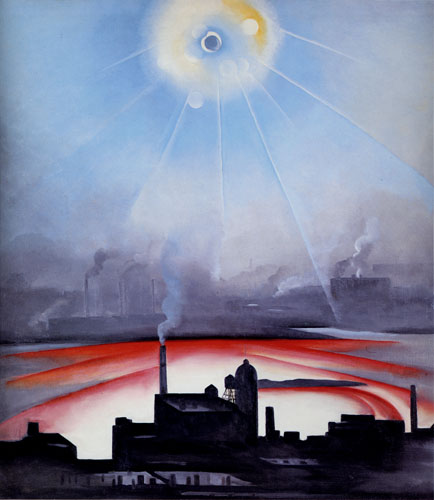
Last Tuesday I went a lecture about Georgia O'Keeffe sponsored by the Pottstown Area Artist Guild. The guest speaker was Ellen O. Nelson, an artist in her own right and probably a certifiable O'Keeffe groupie. Nothing is more engaging than a speaker who is enthusiastically knowledge about a subject.
Long before Georgia O'Keeffe took up residency at the Ghost ranch in New Mexico she was already an established artist in New York City. Ellen O. Nelson spent a lot of time on O'Keeffe's early career with paintings that were influenced by the precissionists and surreal artists of the 1920's
For me it was nice to get past what O'Keeffe is most famous for, her paintings of flowers that amateur critics like to lampoon as floral pelvic exams.
But even in New York you can see the possibilities of things to come. Georgia O'Keeffe has become an icon for many women because she was as independent as she was creative.
On another note today is the 161st anniversary of the publication of Herman Melville's Moby Dick. Moby Dick is seen as the great American novel but originally the book received mixed reviews and didn't even sell all of its first 3,000 copies (so if you have a first edition copy today, it's worth many thousands of dollars). Herman Melville's first few books were all best sellers and some feel Moby Dick killed his writing career much the same way the monstrous white whale killed Captain Ahab.
Herman Melville died in obscurity. It wasn't until the 1920's more than 30 past his death when Moby Dick was "rediscovered" and declared a classic. It became a must read for the intellectuals of the 1930's, 40's and 50's.
Then came the movie.
Now we are spared the chore of reading over 500 pages to find out that in the end the whale wins. It's a shame because Moby Dick is a pretty accessible book if you have the time.
If Moby Dick isn't what you seek, I can recommend Ray Bradbury's Green Shadows, White Whale. One of Bradbury's big breaks was writing the screenplay for the movie. Some parts are contrived but the book is sharp and funny with many pointed insights into the creative process, Ireland in the 1950's, the director John Huston and how making a movie is a lot like making sausage. One of the best parts is when Ray Bradbury writes about how he changed ending of the book in a small but very monumental way -it's a part of the ending that really stayed in my mind ever since I saw the movie as a little kid.
The American car companies have a long history of teasing and frustrating the consumer with concept cars. Back in the 60's one of the great "could have been" concept cars was the Chrysler gas turbine engine. Five prototypes and 50 production cars were produced. The engine did have practical problems and test consumers didn't like the acceleration lag but this was an engine with a tremendous amount of potential. It had few moving parts, could run on almost any liquid fuel and with some future development could meet the California pollution standards without a catalytic converter.
As a bit of trivia the research and development that when into Chrysler's gas turbine engine end up in the Abrams A-1 tank 20 years later. The A-1 is a heavy battle tank that can go 60 plus miles per hour (100km/h).
You may already know of the legendary EV-1, GM's electric car from the early 1990's. California had threaten to raise pollution standards for the state and require all car companies in the state to also sell zero pollution electric vehicles. California is a market no large car company can ignore, if California was a separate nation it would have the sixth largest economy in the world.
If you ever saw the movie Who Killed The Electric Car, you do have to ask did GM build the EV-1 to fail? As an electric car the EV-1 was not a cutting edge vehicle but maybe to GM's shock and dismay the 50 test consumers really like it. All of the EV-1s were leased and at the end of the test period GM reposed them. There were protests and many of the former drivers made ever legal effort to buy their EV-1. Gm had all of the destroyed except one that is now in a museum (minus the drivetrain). It is on display as one of those wild and crazy ideas that just didn't work.
Before the EV-1 was the Lean Machine. It was displayed at the EPCOT center, Disneyland Florida in 1982
What made the Lean Machine spectacular was how it made a three wheel vehicle stable on the road and maybe even more fun to drive than a motorcycle. Practical in bad weather, safe and fun, it could have been the perfect commuter car that could get up to 100 miles per gallon. What impresses me is how simple the technology was. There's no need for gyroscopes or computer assistance.
GM had no plans to produce the Lean Machine back in 1982 and still has no plans to make anything like the Lean Machine today. Like the Prius, it will probably take a foreign manufacturer to establish the market for this kind of car.
Mercedes Benz has their own (and more sophisticated) version of the Lean Machine.
See the Youtube video below.
Volkswagen has a different spin on the sub-compact commuter car. this is from their one-liter car project. It's vehicle that can get 200 miles per gallon
It can be done.
Her are some Youtube videos of the Mercedes F-300, GM's Lean Machine and a car currently made in the Netherlands by the Carver Car Company
It was once rumored back just after the first big oil shocks in the 1970's a GM executive was interviewed about the Chevy Vega. The Vega was a sub-compact car that GM rushed on to the market to help stop the loss of sales to Japanese car companies. The Vega was also known for its lack of quality and when that GM executive as question about that he supposedly said "that GM doesn't really want to build small cars, and once this gas crisis stuff blows over American will go back to the big cars they already love".
Every Friday night we sit down together to watch Fringe. I'm not sure how popular the show is around the world but for us it's a small family tradition. It's a comic book science-fiction type story with dark conspiracies and campy humor. Part of the plot line deals with an alternative world where the World Trade Center is still standing and Zeppelins glide across the skies.
Anachronisms are one of those things that divide people. Some hate them because they the kind of inaccuracies that can pollute the integrity of history in popular culture and others love them partly because they're fun to find and partly because they hint at the possibilities of parallel universes and alternative time lines.
One of the best science fiction novels that use alternative time lines is Man In a High Castle by Phillip K Dick, written in 1962 and the Hogo Award winner in 1963.. His alternative world is one where the United states has lost World War 2 and has been partitioned and occupied. One of the characters is an author who has written a banned book about the United States winning the second World War. You have to admire how Phillip K Dick created stories like this. Another book worth recommending is Ward Moore's Bring The Jubilee (1953); in a interview Phillip K Dick said this book was his inspiration for Man In A High Castle.
History pivots on such small events. The outcome of world history probably would not have changed much if the Hindenburg did not crash and burn in Lakehurst NJ in 1938 -except maybe Led Zeppelin wouldn't have that great photo for the cover art on their second album. The disaster did contribute to the end of large rigid passenger airships but it was the legend more than the facts that killed the concept. To this day airships are seen as less than safe.
The outer fabric skin was coated a mixture of cellulose nitrate and aluminum flakes which did an excellent job of reflecting the sun's heat and preventing the gas bags from over expansion but ironically the coating may have been more flammable than the hydrogen gas.
The Hindenburg's first year of commercial operation was a glowing success travelling almost 200,000 miles, carrying 2,798 passengers and over 160 tons of freight. The Graf Zepplin had nine years of safe service (1928-1937) with 590 commercial flights and was replaced by the Graf Zeppelin 2 that had 30 flights from 1938 to 1940. In the end all of these air giants were scrapped for their aluminum - magnesium alloy structure that was recycled into other aircraft during the war.
There was a darker side to Airship travel back then where Nazi Germany used it for propaganda and political purposes. These aircraft had the prestige of the Space Shuttle back then and many of the Zeppelin flights went to Brazil. The Nazis had developed strong political links with Brazil's elite as well as Portugal's government. Both countries helped supply the Nazi war machine some of which is spelled out in the book Trading With The Enemy by Charles Higman.
After the war no one was interested in air travel by Zeppelin. Airplanes were larger and had the extended ranges to cross oceans. Commercial jet aircraft were to arrive in the 1950's and that meant end of Trans-Atlantic ocean liners as well as Trans-Continental passenger train service too. By then the big airships were just memories and blimps were the the thing of jokes.
And yet every few years the idea of re-purposing the large rigid airship comes up again. The economics are promising because there are things an airship can do that other forms of transportation can not compete with. There is one company in Canada that wants to build heavy lift airships to supply mining operations in the Northwest Territories. An airship can do twice the work at half the cost without the ecological damage of building and maintaining a road .
But the one possibility could be the return to passenger service. Once airships were the fasted way to cross the Atlantic at three times the speed of of an ocean liner. Today airships could offer the opposite of jet travel, leisure instead of speed. Currently there is on company that has a 12 passenger airship that flies tourists over San Francisco and the surrounding wine country.
Once about twenty years ago I spent an afternoon with a fellow who worked with German company that wanted to build a 50 passenger airship that would run from New York City (actually Teterboro Airport) to Atlantic City. Trump Casinos would ferry high rollers on what would have be the best complimentary ride to the gambling mecca along the Jersey Shore. It would be faster than a limo and less cost per passenger than a helicopter -which at the time Trump Casinos were flying people in to a heliport in Egg harbor Township. As a bonus the airship would also be a traveling billboard. The economic changed as other nearby locations, including New York, legalized casino gambling and the Trump casinos lost there edge in Atlantic City.
The airship might return as part of the space age. Felix Baumgartner skydived from the edge of outer space and he was taken up there not on a rocket but on a balloon.
The next giant leap for mankind is cheap and easy access to to outer space. The space elevator once the creation of Arthur C Clarke just hangs on the very edge technological feasibility. I read one paper last year about using balloons to cheaply assist lifting freight up such an elevator for the first 60,000 ft.
Once the Zeppelins were the very apex of travel. And who knows as commercial jet aircraft become the buses of the skies, people once again might want to fly (at least for short distances) in comfort.
What I want to talk about is the Presidential debates tomorrow nigh but first I'd like to digress back to last Friday. I'm not sure if I gracelessly stumbled over some unwritten rule of on-line educate (if I did I'm sorry) or if I unfortunately became a target of interest of somebody who felt that this blog was so offensive that it needed to be shut down. One of my tech friends laughed and said it was a right of passage and most small blogs has had this happen at least once.
People seem to be very edgy these days. These things go in cycles depending on the economy and the political climate. It reminds me of once when I was in New York City. In lower Manhattan there would be hired men handing out advertisements for neighborhood businesses. Almost all of these men represented the very bottom of the city's economy and the majority of pedestrians would walk right by. Except for one man in a suit, who started to curse and scream, and then hit the guy who was handing out the flyers.
Back then New York City was on the verge of bankruptcy, the shine was definitively off the Big Apple and the pundits of that time seriously discussed the end of big cities. As bad as things were I still couldn't understand the reasoning behind hitting a man for doing something as innocuous as passing out advertisements and trying to scrape out a living?
So tomorrow night is the Second Presidential Debate. It's also the anniversary of the founding of Plan Parenthood, that happen 96 years ago and many of the controversies then are still with us now. I don't think the candidates will really talk much about women's rights. Probably there will be little, if any, real policy analysis, it will be more about body language, confidence and the effect on the polling numbers.
Women in the United States had secured the right to vote less than a 100 years ago. Our Constitution still does not have a Equal Rights Amendment -thought as a bit trivia when the United States occupied Japan after World War 2, the Japanese had to include a clause ending all discrimination based on gender and guarantee the same rights to women as to men. An equal rights amendment was good enough for the Japanese in 1945 but still not good enough for American women.
Some people would like to portray what had happened to Malala Yousafzai as an act of Muslim terrorism. It was an act of terrorism but it's potentially possible in every community that feels women can not make their own decisions. -Or that women are property. Or a thing of potential family shame until she is married. Or need to be covered, controlled and completely protected from the world.
The education women is not only an issue of fairness but humanity's survival might depend on it. Statistically the more education a woman has the fewer child she'll give birth to. The children she does have will be healthier and better prepared for school and life. The growth of education for women in China popularized the One Child Policy to the point were majority for families completely support it. What does this mean for the rest of the world? -China will stabilize its population growth by mid-century. We have to ask can this planet feed eight billion people? What happens when there is ten billion people? And if the population should grow beyond that -are we looking a Malthusian crash?
Usually I get to meet a wide range of people on any given day. Last weekend I helped one friend clean out his old studio. He is very conservative Christian with a long history in both mainstream and religious entertainment. The camera equipment he gave me went to another fellow who is as "middle of the road" as you can get. Both are good men but both live in own exclusive worlds.
After tomorrow's debates it will interesting if anything will change. These days the fault lines are sharp and
people not only inhabit their own exclusive worlds but those worlds have their own history, facts and coded language.
Just two more bits of trivia. Planned Parenthood has received Federal money since 1970 when President Richard Nixon signed the Family Planning and Population Research Act. And as one of his first acts as Governor of California in 1967 Ronald Reagan signed the Therapeutic Abortion Act which lead the way to Roe verses Wade.
As one last I thought I'd ad this Youtube video of an old favorite song. The sound quality is only fair and the video is cute and kind of laughable -but the song itself is excellent. The artist is Dan Bern and you can find out more about him at danbern.com